Guide to North Dakota Divorce Records
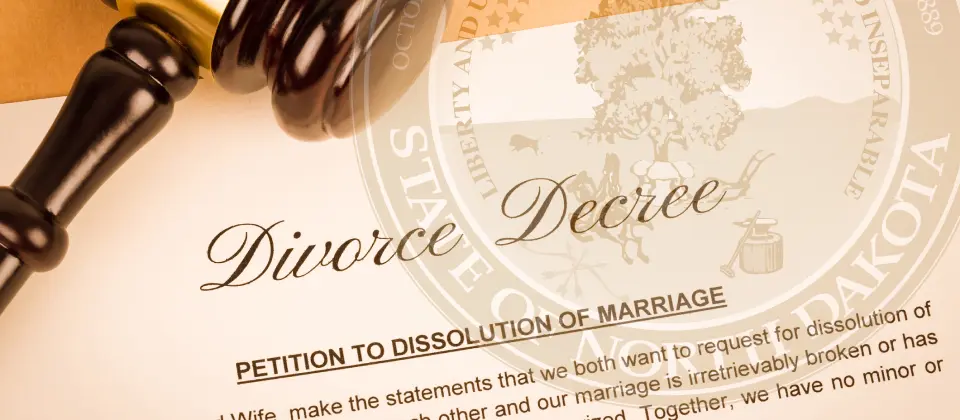
Divorce is governed by individual states in the United States, so the process and access to documents may vary greatly depending on the state or county where the divorce was filed. In North Dakota, divorce cases are judicial proceedings processed through North Dakota's court system and result in court documentation terminating the parties' marriage.
To initiate a divorce proceeding in North Dakota, one party to the marriage must first file a complaint for divorce and a summons with the District Court in the county where either spouse resides. The District Courts of North Dakota have exclusive jurisdiction over all family law issues, including divorce, custody of minor children, child support, and spousal support.
As the divorce progresses through the legal system, each party will have a series of legal filings, motions, responses, and court orders. Each of these documents is prepared at different times during the legal process, and together they make up the parties' divorce record.
Depending on which documents are being requested from the divorce record, a typical North Dakota divorce record can include such items as:
Spouses' names
The county in which the divorce case was filed
The court division that handled the case
Legal grounds for the divorce
Orders for child support or spousal support
Whether the divorce was contested or uncontested
Marital property in North Dakota is distributed equitably under a fair distribution system. In a divorce case with children, the judge will apply the “best interest of the child” standard to determine who gets physical and legal custody.
North Dakota maintains divorce records within its county district courts and, at times, in state agencies. The older divorce records are generally stored on paper or in archival formats, whereas most new divorce records are now available electronically through the court system.
Understanding North Dakota's divorce laws and procedures can make it easier for individuals to locate and obtain the appropriate divorce records.
Where are North Dakota Divorce Records Stored?

At the county level, official case files for a North Dakota divorce are maintained by the Clerk of the District Court in the county where the divorce was filed. Official case files generally include all documents filed with the court, such as summons and complaints, motions, pleadings, orders of the court, and the final judgment of divorce.
Divorce index records are maintained by the North Dakota State Department of Health and Human Services (HHS), Division of Vital Records. These records are based on reports from county-level courts and confirm that a divorce occurred in the state. Divorce indexes typically only contain basic information about the spouses, the county where the divorce was granted, and the date of the judgment.
Is North Dakota a 50/50 Divorce State?
North Dakota does not use the 50/50 divorce rules used in some other states; instead, it follows an equitable distribution rule for dividing property (and debt) during divorce.
Under the equitable distribution law, the judge will attempt to fairly and reasonably divide the property (and debt), based on the facts and circumstances of the parties' marriage, rather than by simply dividing all the property equally. While the division of property may sometimes appear nearly equal, the court still retains the authority to make adjustments, if necessary, to ensure fairness.
In determining the appropriate division of property, North Dakota courts apply the Ruff-Fischer guidelines, the criteria most commonly used in the state's divorce cases. The Ruff-Fischer guidelines provide the court with a means to evaluate the economic and personal characteristics of each spouse prior to determining a fair disposition of the parties' property.
Typical factors that courts will look at when dividing your community property include:
Length of Marriage - Generally, longer marriages may support an equal division of assets, as both parties have contributed equally to the marital estate over the years.
Contributions by Spouses - When evaluating each spouse's contribution to the marital estate, courts consider both financial contributions (income, investments) and non-financial contributions (homemaking, childcare).
Income and Earning Capacity - The court will evaluate each spouse's current income and future earning capacity based on their job skills, education, and training.
Separate vs. Marital Property - Property obtained during the course of the marriage is generally considered “community” property to be divided by the court. However, separate property may include property acquired prior to marriage, as well as gifts and inheritances. They are treated differently by the court depending on whether those assets were used or otherwise affected the marital estate during the marriage.
Fault (if applicable) - Since most divorces are filed as “no fault,” fault is rarely a factor in the divorce process. However, if one party has committed significant acts of marital misconduct (i.e., adultery, wasteful spending, etc.), that misconduct could potentially impact the division of the marital estate.
Types of North Dakota Divorce Records

In North Dakota, there are two main types of divorce records that serve both legal and administrative use. These include the record of the actual divorce proceedings and the court's decision, as well as the formal document issued by the state upon completion of the divorce, indicating that a divorce has been granted.
For instance, a person who needs an official copy of their North Dakota divorce (to update ID documents, apply for remarriage, etc.) can obtain a divorce certificate. For the parties to the divorce proceeding, attorneys, or their accountants, those with financial or custody responsibilities, however, would likely require a divorce decree, which includes all the details of the court's ruling.
North Dakota Divorce Certificate (Certificate of Divorce)
A North Dakota Divorce Certificate can be obtained from the Clerk of the District Court in the County which granted the divorce. The divorce certificate is a summary of the divorce recorded with the state, and verifies that a divorce has occurred; however, it does not contain all the legal details of the divorce.
Typically, a divorce certificate contains standard information such as both parties' names, the county that granted the divorce, and the date that the divorce judgment was entered into the system.
The divorce certificate is typically used for identification purposes, such as when applying for a driver's license, for criminal history checks, when applying to remarry, and for other general administrative uses. To obtain a divorce certificate from the clerk, the individual must provide sufficient information for the clerk to locate the divorce record.
Divorce Decree (Final Judgment of Divorce)
The Divorce Decree, or Final Judgment of Divorce, is the most important document in a divorce in North Dakota. The divorce decree is a final decision made by a judge to formally end a marriage in North Dakota. It states the judge's decision on all issues related to the divorce and becomes a legally enforceable contract between the two parties.
In North Dakota, the divorce decree is signed by the judge of the District Court in the County where the divorce was initiated. Both parties in a divorce are legally bound to follow the rules and requirements set forth in the divorce decree.
Typically, a divorce decree for a divorce in North Dakota will address the following:
Division of Property and Debt - A description of how the marital property and debts are divided between the two spouses.
Alimony (Spousal Support) - If alimony is granted, the divorce decree specifies the amount of alimony, the length of time that the alimony payments will continue, and any other conditions or requirements that must be met prior to receiving the alimony.
Custody and Child Support - The divorce decree outlines the type of custody arrangement between the divorcing spouse(s), each parent's visitation schedule, and the level of child support each divorcing spouse shall pay to the other.
Date Final Judgment Was Entered - The date the judge signed the order terminating the marriage.
How to File for Divorce in North Dakota (Step-by-Step)
Filing for a divorce in North Dakota begins with meeting the state's residency requirement.
Per North Dakota Century Code Section 14-05-17, the plaintiff, or the person who initiates the divorce process, must have resided in the state for no less than six months prior to signing the Final Decree of Divorce. While there may be a six-month residency requirement to obtain a divorce, you can initiate the divorce process as soon as possible, so long as the six-month time period is completed prior to the finalization of the divorce.
Before filing for divorce, it is helpful to know that most divorces are classified as either uncontested or contested. Both types of divorce have their own implications for time, legal complexity, and potential expense.
Uncontested Divorces: When both spouses agree on all major issues prior to filing, an uncontested divorce occurs. Typically, this means agreeing on matters such as property division, debts, child custody, child support, and spousal support. As both parties have agreed to these terms prior to filing, typically, the court process is less complicated and less time-consuming.
In most cases, the judge simply reviews the paperwork submitted by the couple to ensure the agreement was reached fairly and in accordance with North Dakota law, and then enters the Final Judgment of Divorce. Because the parties involved in an uncontested divorce have resolved their issues before filing, it is usually the cheapest and fastest way to terminate a marriage.
Contested Divorce: In cases of contested divorce, there is disagreement over at least one major issue, such as how property should be distributed, with whom the children will reside, and the amount of child and spousal support. In these situations, the case will undergo an extended legal process, including financial disclosure, discovery, court hearings, and possibly a trial.
Each party will typically provide evidence and make its respective arguments to the judge for consideration in deciding the outstanding issues. Because the judge has to thoroughly examine all the facts prior to rendering a final determination, it generally takes much longer for a contested divorce to conclude.
Once you meet the state's residency requirements and have determined what type of divorce you are filing for based on your circumstances, you can follow the steps below to begin your divorce process.
Step-by-Step Divorce Process
The divorce process in North Dakota varies by county and by whether the divorce is contested. However, they generally follow these steps.
Prepare the Filing Packet
The first thing you have to do when you want to start a divorce is prepare all of the paperwork that starts the divorce case. This collection of paperwork, known as the filing packet, provides the court with a general overview of your marital history, financial situation, and the issues you would like the court to decide.
Identify the divorce path (1A vs. 1B): You should also figure out what kind of divorce process you are going to use prior to filing the papers, contested or uncontested.
Typical documents: Typical documents in a filing packet include:
The Summons or Complaint Form is a legal document that asks the court to approve your divorce and outlines the issues you would like resolved.
The Settlement Agreement Form outlines your resolution of each issue listed above.
The Confidential Property/Debt Listing (Exhibit A) Form is used to list the assets and debts of both parties to the divorce.
The Parenting Plan (Exhibit B) details which parent(s) will have custody of the children and outlines each parent's proposed visitation schedule.
The Confidential Information Form protects identifying information from being included in public records.
The Affidavit of Proof and Proposed Judgment is the final paperwork filed with the judge.
Essential supporting documents typically include the marriage certificate, birth certificates for minor children, and comprehensive financial records detailing assets, debts, and income.
Here are the complete North Divorce Forms, along with a self-help guide on how to complete them.
Filing Fees and Fee Waivers (Indigency): The filing fee of $160 must be paid to file your divorce complaint in the District Court. If you are unable to pay this filing fee, you may apply to the court to have it waived by completing a Petition for Waiver of Filing Fees and Financial Affidavit.
A judge will review your income, your expenses, and other financial information in order to determine if you qualify as being financially unable to pay the fees. If the Judge grants your application to waive the fees, you can proceed with filing your divorce complaint without having to pay the fees.
File the Case
When the paperwork is complete, you will need to formally file a petition for divorce at the courthouse.
Where to File: In North Dakota, the District Courts are the state's trial courts with jurisdiction over family law matters. Your divorce complaints must be filed in the county courthouse where you or your spouse lives.
Filing Methods: There are many ways you can send the documents to the courthouse:
In Person: The filing packet can be brought to the clerk's office at the District Courthouse in your county.
By Mail: The documents can also be mailed to the court clerk along with payment of the filing fee or an approved fee waiver request.
Electronic Filing (eFiling): Many courts now permit filings via the state's electronic filing system, where you are able to file documents electronically rather than having to go to the courthouse.
What You Receive: Once the court accepts your divorce paperwork, the clerk opens your divorce case. You can expect to receive a few items at this time.
A Case Number: The case number identifies your divorce case; you will see this number attached to each document filed in it.
Summons: The summons informs your spouse that an action is pending against them (a divorce case) and provides the deadline for their response.
Initial Court Notices: Depending on the jurisdiction, you may also receive some initial court notices. This explains what you need to do next in the divorce process or provides information regarding scheduling requirements and required court forms.
Service of Process (Primarily for Contested Cases)
After the case is filed, the next step is the service of process. Service of process is the act by which the spouse who initiated the divorce serves the other spouse with paperwork indicating that a divorce proceeding has commenced. As a general rule, courts will not proceed with a contested divorce case until the other spouse has been given legal notice of the proceedings.
Service of process is usually accomplished by one of the following processes:
Sheriffs service
Professional process server
Certified mail
Following delivery of the paperwork to the other spouse, the person delivering it must also file a proof of service with the court as evidence that the other spouse was properly notified.
If the spouse cannot be found, the court may permit alternative service methods. In most cases, this requires the filing spouse to demonstrate that they made all reasonable attempts to locate the other party. Once approved by the judge, alternative service can occur by a variety of means, including publishing the divorce notice in a local newspaper or using another court-approved method of notification.
Early Case Phase and Temporary Orders
During a divorce proceeding in North Dakota, a judge can resolve some issues temporarily while the divorce is still pending. Temporary orders create stability and define what to expect for both spouses during the divorce process. They are not a permanent decision regarding the divorce. Rather, they are short-term arrangements to protect both parties until the judge makes a final decision.
In general, courts will attempt to maintain a “practical status quo” during the initial phase of the divorce process. In other words, the judge will generally attempt to create a temporary arrangement that provides continuity for the parties. These may include continuing to have the children attend the same school or living in the same home until the divorce case has been resolved.
Examples of temporary orders include:
Custody and Visitation Arrangements - The court establishes a temporary plan for how the parents will share responsibility for the children's care.
Child or Spousal Support - The court requires one spouse to pay child support or spousal support.
Use of Marital Home - One spouse is allowed to live in the marital home.
Restraining or Protective Orders - The court can enter protective or restraining orders to limit contact between the parties.
Financial Disclosures and Discovery
In most divorce cases in North Dakota, the court expects both parties to provide an honest accounting of their financial affairs; this allows the court to fairly divide marital property and determine child support, spousal maintenance, and other matters. The stage of the process is known as financial disclosure and discovery.
Elements of financial discovery in a North Dakota divorce case include:
Mandatory Financial Statements: Both parties must submit a financial disclosure statement detailing their current financial status. This statement usually lists income, assets, liabilities, and typical monthly expenditures.
Supporting Documentation: To support the financial statement information, the parties may provide documentation to validate its contents. In various situations, supporting documentation may include tax returns, recent pay stubs, bank statements, mortgage documents, retirement account statements, or documentation of interest in a business.
Discovery Tools: If a couple is unable to agree on financial or other issues regarding their divorce, one option is to use formal discovery tools to obtain more information. Both sides can request any information relevant to their case using these tools.
Document Requests: One party may request that the other party provide copies of specified financial documents, such as tax returns, work history documents, bank statements, or investment documentation.
Interrogatories: Formal written questions submitted to the opposing party that must be answered in writing and under oath. The most common reason for submitting interrogatories is to determine financial specifics or factual elements associated with your case.
Subpoenas: They are court-issued orders to third-party entities, such as banks, employers, and other financial institutions, requiring them to produce requested financial documents and records related to the divorce.
Depositions: In some contested divorce cases, either spouse or witnesses may be questioned in an oral examination outside the courtroom. A court reporter will record the testimony. This recorded testimony can be introduced into evidence at a later date.
Case Management and Court Conferences
A case management meeting occurs early in a divorce proceeding, when a judge reviews the case's progress and assesses which important tasks, such as service of process, financial disclosure statements, and discovery, have been completed. In addition, a case management meeting may include setting future deadlines and encouraging the parties to attempt to resolve their differences through settlement or mediation.
A pretrial conference is conducted by the judge after settlement negotiations are unsuccessful. During the conference, the judge reviews outstanding issues of contention and ensures that all parties are properly prepared for the final hearing or trial.
When a divorce is at this stage, most judges want each party to have their affairs in order and to make a sincere effort to move the case forward as quickly as possible. The courts typically expect both parties to have:
Completed the required financial disclosure
Exchanged all relevant documents
Identified what remains to be negotiated or decided
Additionally, courts would like to see the parties attempt some form of negotiation or settlement to avoid going to trial in many divorce cases.
Settlement or Trial
By the time a divorce case is at the final stage of the process in North Dakota, most couples have generally taken one of two routes to resolve their disputes. Usually, they can settle (agree) on how to divide their marital assets, or they can take the dispute to court for a judge to decide the issues.
Most North Dakota divorces are settled by a written agreement between the spouses covering most key issues. This is usually achieved through the following:
Direct negotiations with each other
Mediation, which involves a neutral third party who helps the parties negotiate and reach an agreement
Attorney-led discussions in which attorneys for both spouses engage in negotiations
At this stage in the divorce process, if you are unable to come to an agreement about important items such as spousal support, how property is to be divided, and child custody or visitation, your case will proceed to trial. A judge will then hear your evidence and make the final decision regarding these issues. At this point, it is best that you work closely with your attorney.
The trial will include:
Presenting evidence and testimony of witnesses
Each side submits their proposed findings and judgments
The judge will issue rulings on all remaining issues and determine how the marital property will be equitably divided.
Judgment, Waiting Periods, and Finalization
North Dakota has no “waiting” or “cooling off” period between the filing of divorce papers and the court's entry of a final divorce decree. A judge can grant the divorce decree once all of the statutory requirements are met, and your case is heard. However, the length of time this takes will depend on several factors, including whether the divorce is contested, the exchange of paperwork, and the court's workload.
North Dakota also typically does not require a “waiting period” before a spouse can remarry after the divorce is finalized. When a judge grants a divorce, each of the two former spouses may lawfully remarry unless the divorce judgment specifies otherwise.
In North Dakota, a divorce is final when a judge signs and files the divorce judgment with the court clerk.
Child Custody and Child Support in North Dakota Divorces
When a couple with children in North Dakota divorces, the court must decide how to divide parental responsibility. The judges focus on making arrangements to create a stable environment and ensure the child's physical and emotional needs are met during this time of separation.
North Dakota uses the “best interest of the child” model to determine custody. Therefore, the courts consider a number of factors to determine which arrangement will best promote the child's physical, mental, social, and emotional development. Some of these factors include:
How close is the child to both parents?
Who can better take care of the child?
What kind of home and educational environment has the child experienced?
Has there been a history of domestic violence or other unstable relationships?
Legal Custody vs. Physical Custody
The legal system in North Dakota defines two basic components of custody of children:
Legal Custody is the right of a parent to make significant decisions regarding the child's life, such as schooling, medical care, and religious upbringing. The court can grant authority to make these decisions to either one parent (sole) or to both parents (joint).
Physical custody addresses where the child will reside on a daily basis, and how the parents will divide up time with their child. In some cases, the court will designate one parent as the primary residential parent; in others, the parents will be required to develop a parenting plan that includes a detailed schedule of parenting time.
Child Support Guidelines and Enforcement
The amount of child support payable in North Dakota is influenced by the state's child support guidelines, which take into consideration factors such as:
Each parent's income
The number of children that need to be supported by each parent
How much time each parent spends with the children
Other expenses for the child
Health insurance premiums
Once an order for child support has been entered, it is considered to be a legally enforceable obligation. If a parent fails to make their court-ordered child support payments, the other parent may pursue various remedies available to him/her under the law, including but not limited to:
Suspension of driver's licenses or professional licenses
Wage withholdings
Interception of tax refunds
Collection action taken by the state's child support enforcement system
Property, Debt, and Alimony in North Dakota Divorces
A North Dakota court will also decide on debt and spousal support (alimony) in a divorce.
North Dakota follows the equitable distribution model for dividing marital property; therefore, the court may divide marital property in an “equitable” manner, but need not divide it equally. In addition, a judge has the authority to distribute marital property, but not separate property.
Marital Property: Marital property consists of the assets or income generated by either party during their marriage, including homes, vehicles, bank accounts, retirement accounts, and business profits.
Separate Property: Generally remains with the spouse who owns it, including property owned before the marriage, inheritances, and gifts given specifically to one spouse, except they become mixed with marital property.
In some divorce cases, spousal support, also called alimony, is ordered for the purpose of maintaining the economic well-being of the lower-income-earning spouse. In North Dakota, there are multiple types of alimony that can be ordered:
Periodic Alimony: Ongoing periodic payments made by one spouse to another for a specified period of time (such as monthly) for the sole purpose of supporting the receiving spouse.
Rehabilitative Alimony: These payments are made to assist a spouse in obtaining education or training to achieve economic self-sufficiency.
Lump-Sum Alimony: A single payment made to the receiving spouse to pay off their debt and other obligations, and does not require ongoing payments.
Errors, Omissions, and Corrections in North Dakota Divorce Records
Sometimes errors or omissions occur in North Dakota divorce records. There are several reasons this could happen, such as misspellings of names, incorrect dates, or transposed digits. You can request corrections if you notice errors and omissions in your divorce records so that your record will correctly reflect what was decided by the court.
All corrections to divorce records, whether on the divorce certificate or the final decree, must be made through the North Dakota District Court where the divorce was granted. To correct errors on the divorce decrees, file a motion to amend the records, include a copy of your final judgment, and a valid government-issued ID. Amending errors on your divorce certificate requires submitting a correction request along with supporting documents to the Clerk's Office.
Once the corrections have been approved and processed, you should be able to obtain updated certified copies of the corrected divorce record from the Clerk of the District Court.
How to Access North Dakota Divorce Records

You may get a copy of your divorce record in North Dakota using the following options:
Online
Divorce Certificates: You can obtain an official copy of a divorce certificate from North Dakota online using VitalChek, a company approved to process online requests for the state's vital records office.
Divorce Decree: Generally, you cannot find a copy of your divorce decree online, as even North Dakota's online Court Records Inquiry only carries basic information on divorce cases. If you need the complete divorce decree, contact the Court Clerk's Office where your divorce was filed.
In Person
Divorce Certificates: Visit the North Dakota Department of Health and Human Services to obtain a divorce index or certificate in person.
Divorce Decrees: The District Court Clerk in the county where your divorce was granted can grant you a copy of your complete divorce decree or certified court copies. It costs about $1 per page for copies and around $10 for certification of the document.
By Mail
Divorce Certificates: If you prefer to get the divorce certificate by mail, you can request the document from the Vital Records office of the North Dakota Department of Health and Human Services.
Divorce Decrees: If you want to obtain a copy of your complete divorce decree, you will need to mail your request to the District Court Clerk's Office in the county where you obtained your divorce. Include the fees and a self-addressed and stamped envelope for mail requests so the document can be shipped to you.
North Dakota Courthouses That Handle Divorces
Knowing which court will hear your divorce case in North Dakota is important for filing your case properly and locating records later. In North Dakota, divorce cases are heard in a specific section of the judicial system.
Court Authority for North Dakota Divorce Cases
Divorce cases are heard in the North Dakota District Courts. The District Courts have the authority to hear and decide family law matters, including divorce, child custody, child support, and the division of marital property. Therefore, a divorce case may only be finalized in the State of North Dakota if it was filed and decided on in a District Court and a District Court judge signs off on the final judgment of divorce.
County-Based Filing
Typically, a divorce case is filed in the district court where the plaintiff resides. However, since every county in the state has a District Court Clerk's Office, the correct courthouse is the one serving the county where either party lives. You can find final divorce decrees for some popular North Dakota counties:
Jurisdiction Basics
Only the District Courts have jurisdiction to handle divorce cases in North Dakota. Other courts, such as Municipal Courts and Specialty Courts, do not have the authority to grant divorces or issue divorce decrees. As a result, all divorce filings, hearings, and final judgments of divorce occur within the District Court System.
Examples of North Dakota District Courts
Each county has a District Court and maintains its own records. Here are examples of county courts in the state:
South Central Judicial District Court (Burleigh County)
East Central Judicial District Court (Cass County)
Northeast Central Judicial District Court (Grand Forks County)
Northwest Judicial District Court (Ward County)
Northeast Judicial District Court (Ramsey County)
Role of the District Court Clerk
District Court Clerks are primarily responsible for performing many administrative tasks that take place as part of a divorce proceeding. These duties include:
Accepting filings for divorces
Assign a case number to each divorce action filed
Keeping permanent records of the divorce action
Providing a certified copy of the divorce decree as requested by the parties involved
Individuals seeking copies of divorce documents or information about their case will typically contact the District Court Clerk in the county where they finalized their divorce.
FAQ
Are divorce records public in North Dakota?
Yes, most divorce case records filed in North Dakota District Courts are public records per the Sunshine Laws. However, there may be sensitive information, such as financial details and minor information, that is protected or sealed by the court.
What is the difference between a certificate and a decree?
A divorce certificate is a summarized record confirming a divorce has occurred. A divorce decree, on the other hand, is the full court order issued by the judge and contains the terms of the divorce, such as property division, custody arrangements, spousal support, and more.
Do I need to know the county?
Yes. Knowing the county will help with your search for files quickly, as divorce decrees are kept by the District Court Clerk in the county where the divorce was granted. If you are not sure of the county, the state's vital records index may help narrow your search.
How far back do records go?
The divorce index maintained by the North Dakota Department of Health and Human Services generally holds divorce records dating back to 1949. Older records are generally kept in the district court archives in the county where the divorce was granted.
How much does it cost?
The fee for records can vary based on the type of record you want. Court clerks usually charge about $1 per page for copies and about $10 for a certification, but these amounts can vary by county. Online services like VitalChek may also have processing fees.
Can I Search North Dakota Divorce Records for Free?
Generally, no. Divorce records, especially divorce decrees, are not available for free online. Third-party platforms that may provide this service may charge a fee to access the documents. However, you can view basic divorce record information for free online via court websites or at the courthouse.
Table of Contents
- Where are North Dakota Divorce Records Stored?
- Is North Dakota a 50/50 Divorce State?
- Types of North Dakota Divorce Records
- How to File for Divorce in North Dakota (Step-by-Step)
- Step-by-Step Divorce Process
- Child Custody and Child Support in North Dakota Divorces
- Property, Debt, and Alimony in North Dakota Divorces
- Errors, Omissions, and Corrections in North Dakota Divorce Records
- How to Access North Dakota Divorce Records
- North Dakota Courthouses That Handle Divorces
- FAQ